



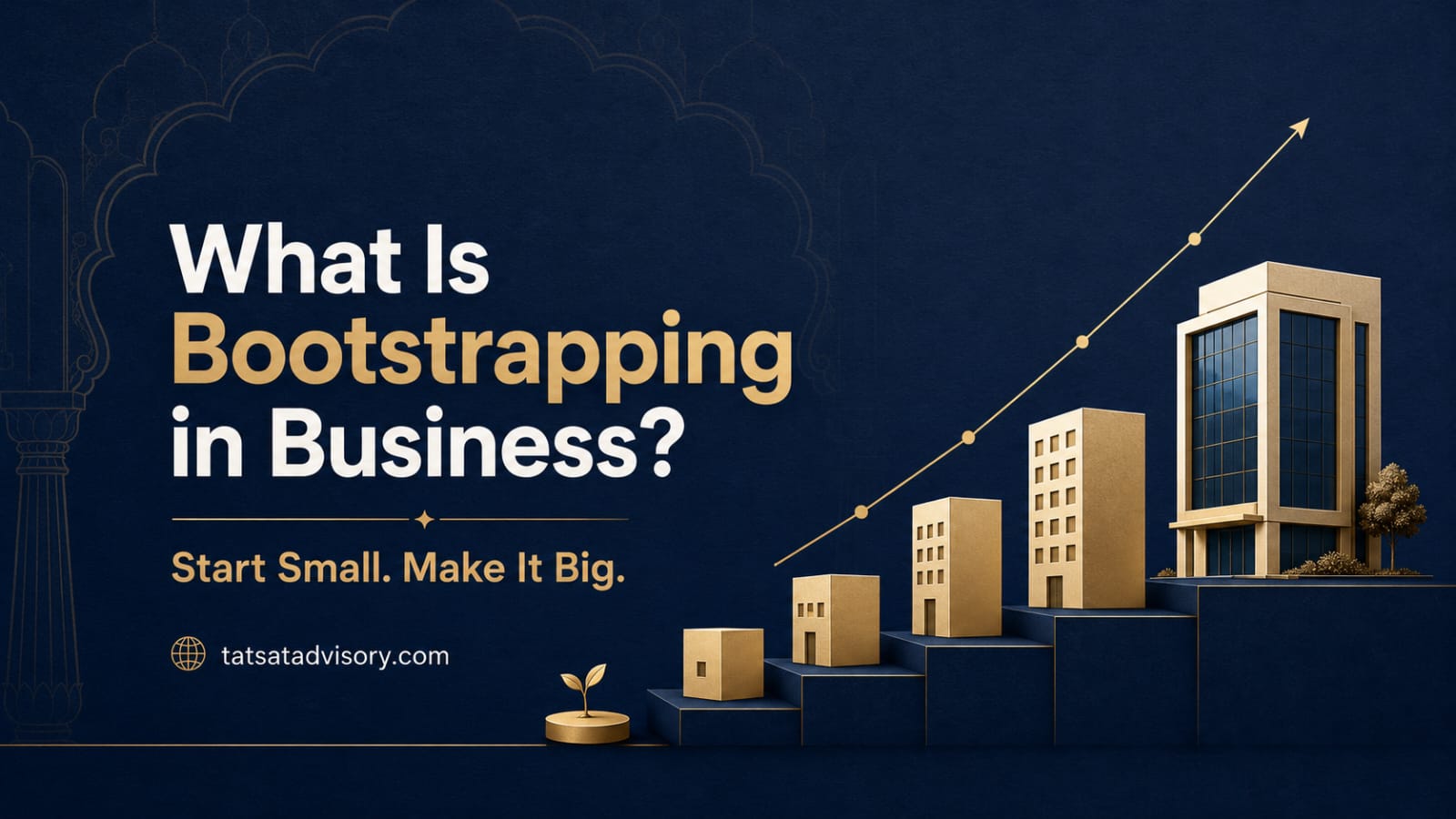


Many successful businesses do not begin with a large investment, an expensive office or millions of rupees from investors. They begin with a useful idea, a few paying customers and a founder who carefully reinvests every rupee earned.
This method of building a business is known as bootstrapping.
Bootstrapping allows an entrepreneur to start with limited resources, learn directly from the market and grow without immediately depending on investors or large business loans. Growth may be slower during the initial stages, but the founder generally retains greater control over the business.
Starting small does not mean thinking small. It means building the business in stages, proving that customers are willing to pay and expanding only when there is sufficient demand.
What Is Bootstrapping in Business?
Bootstrapping means starting and growing a business primarily with your own resources and the income generated by the business.
Instead of raising a large amount from investors at the beginning, a bootstrapped business may use:
- The founder’s personal savings
- Income from initial customers
- Advance payments against orders
- Supplier credit
- Existing skills, equipment or workspace
- Profits reinvested into the business
- Small and carefully planned borrowing, where necessary
The objective is to keep initial expenses low, begin generating revenue and use that revenue to support future growth.
Bootstrapping Does Not Mean Running a Business Without Money
Every business requires some resources. Even a home-based consultancy needs a computer, internet connection, software and time. Bootstrapping means using those resources carefully and avoiding unnecessary expenses before the business has proven its potential.
For example, a new service provider in Jaipur may begin from home instead of immediately renting a large office. A food business may start with pre-orders instead of opening a full restaurant. A clothing brand may launch a limited collection instead of purchasing a large quantity of inventory.
The business starts with what it genuinely needs and adds more resources as revenue grows.
Why Do Entrepreneurs Choose Bootstrapping?
Complete Control Over the Business
When founders use their own resources, they generally retain ownership and decision-making authority. They do not have to give away a share of the business at an early stage or obtain investor approval for every important decision.
Greater Focus on Real Customers
A bootstrapped business survives only when customers are willing to pay. This encourages the founder to solve genuine problems instead of concentrating only on presentations, valuations or fundraising.
Financial Discipline
Limited resources force entrepreneurs to examine every expense. They learn to negotiate, prioritise and measure whether an expenditure is producing a useful result.
Freedom to Grow at a Suitable Pace
Outside investors may expect rapid growth within a fixed period. A bootstrapped founder can expand according to customer demand and operational capacity.
Stronger Position for Future Fundraising
A business with customers, revenue and a proven model may be in a stronger position if it decides to approach lenders or investors later. The founder can demonstrate what the business has already achieved instead of presenting only an idea.
Can a Small Business Really Become Big Through Bootstrapping?
Yes, but bootstrapping is not a shortcut. It requires patience, consistent execution and careful financial management.
A small business becomes bigger by repeatedly completing a simple cycle:
- Offer a useful product or service.
- Acquire paying customers.
- Deliver the promised value.
- Collect revenue on time.
- Control unnecessary expenses.
- Reinvest part of the profit.
- Improve the offer and reach more customers.
When this cycle is repeated successfully, the business can grow without needing a large investment on the first day.
How to Bootstrap a Business Successfully
1. Start With a Specific Problem
A business should solve a problem for which customers are willing to pay. Avoid beginning with a broad idea such as “I want to start an online business.” Define the customer, the problem and the proposed solution clearly.
For example:
- Helping local manufacturers obtain better product photographs
- Providing bookkeeping support to small shops
- Delivering customised gift boxes for corporate events
- Creating social media content for Jaipur-based businesses
- Providing specialised maintenance services to offices
A specific offer is easier to explain, test and sell.
2. Use the Skills and Resources You Already Have
Before purchasing equipment or hiring employees, identify what is already available to you.
This may include:
- Your professional knowledge
- An existing laptop or smartphone
- A room that can serve as a temporary workspace
- Industry contacts
- Relationships with suppliers
- Experience in sales or customer service
- Access to a particular market or community
The best bootstrapped business often begins at the intersection of an existing skill and a real customer problem.
3. Launch a Minimum Viable Offer
You do not always need a complete product range, sophisticated application or expensive office before approaching customers. Begin with the smallest version of your product or service that provides genuine value.
A minimum viable offer could be:
- One service package instead of ten
- A limited collection instead of a complete catalogue
- A manual service before developing software
- A simple website instead of a complex mobile application
- One delivery area instead of the entire city
The purpose is not to offer poor quality. It is to test the essential idea without spending heavily on features customers may not want.
4. Find Paying Customers Early
Compliments, social media likes and survey responses do not necessarily prove that a business will succeed. A paying customer provides much stronger evidence.
Speak directly with potential customers, show them the offer and ask whether they are willing to purchase it. Their questions and objections will help you improve the business.
Early customers may be found through:
- Personal and professional networks
- Referrals
- Local business associations
- Direct outreach
- Google Business Profile
- Social media content
- Online marketplaces
- Industry events and exhibitions
5. Keep Fixed Expenses Low
Fixed expenses must be paid even when sales are weak. High rent, large salaries, expensive software subscriptions and vehicle instalments can create pressure before the business develops stable revenue.
During the initial stage, consider:
- Working from home or a shared workspace
- Hiring freelancers for specialised assignments
- Using affordable software tools
- Leasing equipment when appropriate
- Maintaining limited inventory
- Negotiating with suppliers
- Using digital marketing before expensive traditional advertising
The objective is not to avoid every expense. Spend where it improves the product, customer experience or ability to generate revenue.
6. Sell Before You Expand
Entrepreneurs sometimes invest heavily in inventory, machinery or office space before confirming customer demand. Bootstrapping follows the opposite approach: validate demand before making a major commitment.
Depending on the nature of the business, you may use:
- Pre-orders
- Customer advances
- Trial packages
- Limited launches
- Paid pilot projects
- Appointment-based services
Never promise something you cannot deliver. Customer advances should be accepted only when the business has a realistic plan and the capacity to fulfil the order.
7. Reinvest the Early Profits
The first profits of a bootstrapped business should not be treated entirely as personal income. A portion may need to be reinvested to improve the business.
Reinvestment may be used for:
- Better equipment
- Additional inventory
- Marketing
- Employee training
- Technology and automation
- Product development
- Entering a new market
Reinvesting profits allows the business to expand gradually without creating excessive repayment obligations.
8. Maintain Separate Business Finances
Open a separate bank account for the business and record every receipt and expense. Mixing personal and business transactions makes it difficult to determine whether the enterprise is genuinely profitable.
Maintain basic records of:
- Sales
- Operating expenses
- Customer payments due
- Supplier payments due
- Inventory
- Taxes
- Owner withdrawals
- Existing loans and instalments
Accurate financial records are also important if the business later applies for a loan or seeks an investor.
9. Protect Your Cash Flow
Profit and cash flow are not the same. A business may record a profitable sale but still face difficulty if the customer pays after 60 days.
To protect cash flow:
- Ask for an advance where commercially reasonable.
- Issue invoices promptly.
- Follow up on overdue payments.
- Negotiate suitable credit periods with suppliers.
- Avoid purchasing excessive inventory.
- Maintain an emergency business reserve.
- Do not use short-term funds for long-term assets.
10. Build Systems Before Growing Rapidly
Growth can create problems if the business depends entirely on the founder. Before increasing the number of customers, create simple systems for sales, billing, delivery, customer support and follow-ups.
Document repeated tasks so they can eventually be delegated to an employee or handled through technology. A business becomes scalable when it can serve more customers without a proportional increase in confusion and cost.
A Practical Example of Starting Small
Suppose a person in Jaipur wants to start a customised corporate-gifting business. Instead of renting a showroom and purchasing a large quantity of products, the founder could:
- Create a small catalogue using samples.
- Contact local companies, schools and event planners.
- Accept customised orders with an advance payment.
- Purchase products only after receiving confirmed orders.
- Deliver the orders personally during the initial stage.
- Collect customer feedback and photographs.
- Use profits to improve packaging and marketing.
- Hire assistance only when regular order volume justifies it.
This approach reduces the initial investment and allows the founder to understand customer preferences before committing to a large inventory.
When Should a Bootstrapped Business Consider a Loan?
Bootstrapping does not mean that a business must avoid borrowing forever. A properly planned loan can accelerate growth when the business already has demand and a clear repayment source.
Borrowing may be considered when:
- The business is losing confirmed orders because of limited capacity.
- Machinery can produce measurable additional revenue.
- Working capital is locked in genuine receivables.
- A profitable location or expansion opportunity is available.
- The expected cash flow can comfortably support repayments.
- The founder wants to retain ownership instead of bringing in an investor.
The type and tenure of the loan should match the purpose. A long-term asset should not normally be financed through expensive short-term borrowing.
When Should a Bootstrapped Business Consider an Investor?
Investor funding may be useful when the opportunity requires rapid expansion, specialised expertise or a level of investment that the business cannot reasonably generate through internal profits.
However, investment means sharing ownership and, in many cases, decision-making authority. A founder should not raise equity only because it appears prestigious.
Before approaching an investor, understand:
- How much funding is genuinely required
- How the money will be used
- The valuation of the business
- The ownership being transferred
- The investor’s role
- The expected growth plan
- The conditions for a future exit
Common Bootstrapping Mistakes
Trying to Do Everything Alone
Controlling expenses does not mean performing every task personally. Legal, accounting, technical or compliance work may require professional assistance. Trying to save money in the wrong place can create larger costs later.
Choosing Cheapness Over Quality
Customers will not continue buying a poor product simply because the business is bootstrapped. Control expenses without compromising essential product quality, safety or customer service.
Waiting Too Long to Launch
Some founders continue planning because they want the business to look perfect. Real customer feedback is usually more valuable than endless preparation.
Ignoring Marketing
A good product cannot grow if potential customers do not know it exists. Set aside time and money for consistent marketing, even if the initial budget is limited.
Withdrawing All the Profit
If every rupee of profit is removed for personal use, the business may never build the capacity to grow. Decide in advance how profits will be divided between reinvestment, reserves and personal income.
Borrowing Without a Clear Return
Borrowing should be connected to a productive purpose and a visible repayment source. A loan taken merely to maintain appearances, purchase an unnecessary asset or cover recurring losses can weaken the business.
Bootstrapping Versus External Funding
| Factor | Bootstrapping | External Funding |
|---|---|---|
| Ownership | The founder generally retains ownership. | Equity investors may receive ownership. |
| Growth speed | Growth is usually gradual. | Growth may be accelerated with additional capital. |
| Decision-making | The founder has greater independence. | Investors or lenders may impose conditions. |
| Financial pressure | Lower if expenses remain controlled. | Loans create repayments; investors expect growth and returns. |
| Market validation | Revenue must come from paying customers early. | A business may operate longer before becoming profitable. |
Neither approach is automatically superior. The appropriate option depends on the industry, market opportunity, capital requirement and founder’s objectives.
How to Turn a Small Beginning Into a Large Business
A bootstrapped business does not become successful merely by spending less. It becomes successful by using limited resources intelligently.
To build something substantial:
- Stay close to your customers.
- Improve the product based on genuine feedback.
- Protect quality and reputation.
- Maintain accurate financial records.
- Reinvest in areas that generate measurable results.
- Create repeatable operating systems.
- Hire only when the role has a clear purpose.
- Use debt carefully and only for productive requirements.
- Expand after proving demand in the existing market.
- Remain patient enough to allow compounding to work.
Large businesses are often built through thousands of small, sensible decisions rather than one dramatic investment.
Start With What You Have, but Build With a Plan
You may not have the funds to open a large office, hire a complete team or launch across several cities today. That does not mean you cannot begin.
Start with a focused offer. Find the first paying customer. Deliver better than expected. Record what works, improve the process and reinvest carefully. Each stage should make the next stage possible.
Bootstrapping is not about remaining small forever. It is about earning the right to grow.
Business Funding and Growth Assistance in Jaipur
As a bootstrapped business grows, it may eventually require working capital, machinery finance, a business loan or a loan against property. The decision should be based on actual cash flow and a clearly identified business opportunity.
Tatsat Advisory assists entrepreneurs and established businesses in Jaipur in understanding suitable funding options and preparing their business loan proposals.
Planning to start, stabilise or expand your business in Jaipur?
Connect with Tatsat Advisory to discuss your business and funding requirements.
Frequently Asked Questions
What does bootstrapping mean in business?
Bootstrapping means starting and growing a business mainly through the founder’s resources, customer revenue and reinvested profits instead of relying heavily on outside investors or large loans.
Can I start a business with very little money?
Some service-based, digital and order-based businesses can begin with limited capital. However, the required investment depends on the industry, equipment, licences, inventory and operating expenses involved.
Is bootstrapping suitable for every business?
No. Businesses requiring substantial infrastructure, research, machinery or regulatory approvals may need external funding. Bootstrapping is more practical when the business can start small and generate revenue relatively early.
Can a bootstrapped business take a loan?
Yes. Bootstrapping does not prohibit borrowing. A carefully structured loan may be used when it supports a productive business requirement and the expected cash flow can comfortably cover repayments.
What is the biggest advantage of bootstrapping?
The founder generally retains greater ownership and control while developing strong financial discipline and focusing on paying customers.
What is the biggest risk of bootstrapping?
Limited capital can restrict marketing, recruitment, product development and expansion. Growth may also be slower, and the founder may experience significant personal pressure during the initial stage.
When should a small business expand?
Expansion should generally be considered when the business has consistent demand, positive unit economics, reliable operations and sufficient cash flow or appropriately structured funding.
Disclaimer: This article is provided for general informational purposes only. It does not constitute financial, investment, legal or taxation advice. Business o