



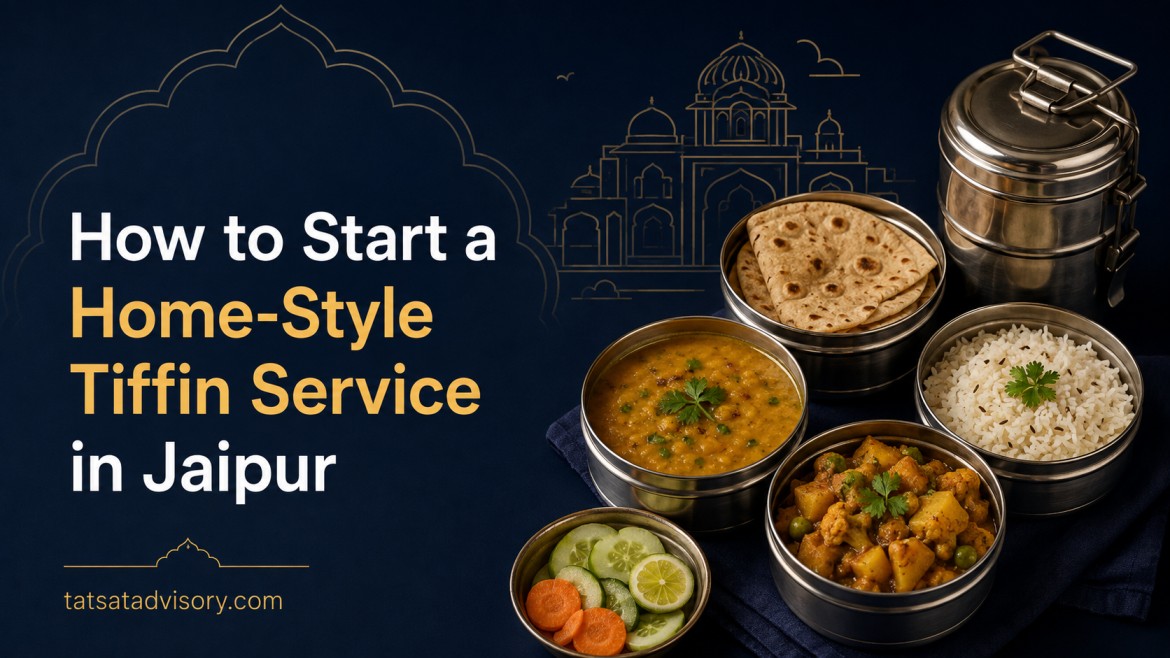


How to Start a Home-Style Tiffin Service in Jaipur
A home-style tiffin service can be started in Jaipur with relatively modest infrastructure compared with a full restaurant. It can serve office employees, students, senior citizens, hospital attendants and people living away from their families who want simple, hygienic and regularly delivered meals.
However, cooking good food is only one part of the business. A successful tiffin service requires portion control, consistent taste, safe packaging, timely delivery and careful calculation of every meal’s cost.
This practical guide explains how to start a home-style tiffin service in Jaipur, select customers, design the menu, calculate prices, obtain applicable registrations and build a dependable subscription business.
Why Start a Home-Style Tiffin Service in Jaipur?
Jaipur has a large number of offices, colleges, coaching centres, hospitals, hostels, paying-guest accommodations and working households. Many people in these segments need regular meals but may not want restaurant-style food every day.
A tiffin business can offer several advantages:
- It may be started from an eligible home kitchen
- Customers can subscribe weekly or monthly
- Advance orders make production easier to plan
- A focused menu can reduce kitchen complexity
- Regular routes can make delivery more efficient
- The business can expand gradually instead of opening a large outlet immediately
The apparent simplicity can also be misleading. Low pricing, delivery costs, food wastage and inconsistent customer numbers can quickly weaken profitability. A tiffin business should therefore be planned as a commercial operation—not treated as casual home cooking.
Step 1: Decide Whom You Want to Serve
A common mistake is trying to deliver to everyone across Jaipur. Begin with one customer group and a limited delivery area.
Office Employees
Office customers generally need lunch delivered within a fixed time window. Group orders from one office can reduce the delivery cost per meal.
Students and Paying Guests
Students may require affordable lunch-and-dinner subscriptions. They usually value predictable pricing, filling portions and flexible pause options.
Senior Citizens
This segment may prefer simple meals, lower oil, mild spices and reliable daily delivery. Avoid making medical or therapeutic claims unless qualified professionals are involved.
Hospital Attendants
Families staying near hospitals may need uncomplicated meals at short notice. Delivery coordination and simple ordering can become important advantages.
Working Couples and Families
Working households may order dinner, rotis, dal, vegetables or complete family meal packs on selected days.
Corporate Meal Contracts
Small offices may require a fixed number of lunches on working days. Institutional orders can create stable volume but may involve credit periods and strict service expectations.
Step 2: Select a Limited Delivery Area
Delivery can determine whether a tiffin service earns or loses money. A ₹100 meal cannot support an unlimited delivery radius.
Begin with a concentrated area such as:
- One large residential sector
- A cluster of offices
- A college and nearby PG accommodations
- A hospital and its surrounding residential area
- A group of adjacent neighbourhoods
For example, serving 20 customers inside one office building is operationally different from delivering to 20 individual addresses spread across Jaipur.
Before accepting an order, calculate:
- Distance from the kitchen
- Travel time during peak traffic
- Number of deliveries on the same route
- Fuel and delivery-person cost
- Time by which the meal must arrive
- Whether empty containers need to be collected
Step 3: Choose the Right Business Model
Monthly Subscription
Customers pay for a defined number of meals in advance. This model improves cash flow and helps estimate daily production.
Weekly Subscription
A weekly plan reduces the commitment for new customers and may be useful during the initial launch period.
Pay-Per-Meal
Customers order only when required. This provides flexibility but makes production less predictable.
Lunch-and-Dinner Package
A combined plan may improve revenue per customer, although it requires two separate production and delivery cycles.
Corporate Contract
The business supplies a fixed number of meals to an office, institution or workplace. Confirm payment terms, minimum orders and cancellation conditions in writing.
A practical approach is to use subscriptions as the core model while allowing a limited number of trial and one-time orders.
Step 4: Design a Simple Home-Style Menu
The menu should feel varied to customers without making the kitchen unnecessarily complicated.
A standard vegetarian tiffin may include:
- One dal or curry
- One seasonal vegetable
- Four rotis
- Rice
- Salad or pickle
You may create separate plans such as:
- Basic lunch tiffin
- Standard lunch with dal and rice
- Lunch-and-dinner subscription
- Office meal box
- Family dinner pack
- Low-spice meal plan
- Jain meal option, where operationally practical
If you offer Jain, vegan, high-protein or allergy-sensitive meals, clearly define the ingredients and preparation limitations. Do not promise complete allergen isolation unless the kitchen has the systems required to prevent cross-contact.
Sample Weekly Vegetarian Menu
| Day | Dal or Curry | Vegetable | Accompaniments |
|---|---|---|---|
| Monday | Dal tadka | Aloo gobhi | Roti, rice and salad |
| Tuesday | Rajma | Jeera aloo | Roti, rice and pickle |
| Wednesday | Chana dal | Seasonal mixed vegetable | Roti, rice and salad |
| Thursday | Kadhi | Cabbage and peas | Roti, rice and pickle |
| Friday | Chole | Aloo capsicum | Roti, rice and salad |
| Saturday | Dal fry | Bhindi | Roti, rice and pickle |
| Sunday | Special paneer dish | Seasonal vegetable | Roti, rice and a small sweet |
This is only an illustration. Your actual menu should reflect ingredient prices, customer preferences, seasonality and kitchen capacity.
Step 5: Standardise Recipes and Portions
A home-style tiffin service must provide consistency even when different employees are working in the kitchen. Written recipes and defined serving sizes are therefore essential.
Standardise:
- Raw ingredients required for each batch
- Quantity of oil, salt and spices
- Number and weight of rotis
- Quantity of rice, dal and vegetables per tiffin
- Cooking and cooling times
- Packaging procedure
- Maximum safe holding period
Use appropriate measuring utensils and weighing scales instead of relying entirely on visual estimates. Without portion control, food cost can change from one day to another.
Step 6: Calculate the Complete Cost of a Tiffin
Do not price the tiffin by considering only vegetables, flour and dal. The real cost should include:
- Raw ingredients
- Cooking oil and spices
- LPG, electricity and water
- Packaging or reusable container cost
- Kitchen assistance
- Delivery expenses
- Food wastage
- Cleaning supplies
- Marketing and payment charges
- Applicable taxes and compliance costs
- A proportionate share of fixed expenses
Illustrative Meal-Cost Calculation
| Cost Component | Illustrative Amount |
|---|---|
| Ingredients | ₹38 |
| Fuel and utilities | ₹5 |
| Packaging | ₹8 |
| Kitchen labour | ₹8 |
| Delivery allocation | ₹15 |
| Wastage and overhead allocation | ₹6 |
| Illustrative total cost | ₹80 |
These figures are only an example. Your actual cost may be lower or higher. If this tiffin is sold for ₹90, the apparent ₹52 difference over the ingredient cost is not the real profit. After accounting for all expenses, the margin would be much smaller.
Step 7: Set Prices and Subscription Rules
Your price should cover costs, provide a reasonable margin and remain acceptable to the selected customer segment.
Clearly define:
- Price per meal
- Weekly and monthly subscription prices
- Number of meals included
- Delivery areas and charges
- Order cutoff time
- Sunday and holiday policy
- Rules for pausing a subscription
- Refund and cancellation terms
- Lost or damaged container charges
For example, customers may be required to pause the next day’s meal before a fixed time. Without a cutoff policy, last-minute cancellations can create substantial wastage.
Step 8: Estimate the Initial Investment
A home-based operation may require less investment than a commercial kitchen, particularly if suitable equipment is already available. However, the existing kitchen should not automatically be assumed to be suitable for commercial production.
Possible startup expenses include:
- Cooking utensils and commercial-grade equipment
- Additional burners and safe gas installation
- Refrigerator and storage containers
- Stainless-steel preparation tables
- Water purification system
- Handwashing and cleaning arrangements
- Food weighing and portioning equipment
- Packaging or reusable tiffin containers
- Insulated delivery bags
- Billing and order-management system
- Registration and professional expenses
- Initial ingredients
- Branding and local promotion
- Delivery vehicle or delivery-partner deposit
- Initial working capital
Start by preparing a detailed list and obtaining actual quotations. Keep a reserve for ingredients, delivery expenses and salaries during the first few months.
Step 9: Choose Disposable or Reusable Packaging
Disposable Containers
Disposable packaging simplifies delivery and collection but creates a recurring expense. Use food-grade containers suitable for the temperature and type of food being packed.
Reusable Tiffin Boxes
Reusable containers may reduce long-term packaging waste but require:
- Container deposits
- Numbering or customer tracking
- Collection routes
- Proper washing and sanitisation
- Replacement rules for loss or damage
You can also use disposable packaging for trial orders and reusable containers for regular subscribers.
Step 10: Plan the Kitchen for Food Safety
Whether the business operates from a home or commercial kitchen, food safety must remain a priority.
The kitchen should provide:
- Safe water for cooking and cleaning
- Separate covered storage for ingredients
- Protection against pests and contamination
- Clean food-contact surfaces
- Covered waste bins
- Appropriate refrigeration
- Personal hygiene arrangements
- Separation of cleaning chemicals from food
- A system for checking raw-material quality
- Regular cleaning records
Cooked meals should not remain at unsafe temperatures for extended periods. Production and delivery schedules should be designed so that food reaches customers promptly.
Step 11: Obtain the Applicable Registrations
FSSAI Registration or Licence
Home-based food businesses are required to obtain the appropriate FSSAI registration or licence according to their activity and eligibility.
FSSAI’s eligibility document updated on 1 April 2026 specifically recognises home-based canteens and dabba wallas as a food-service category. According to that document, operations with annual turnover up to ₹1.5 crore fall under registration, while those above ₹1.5 crore require a State Licence. Since rules can change and the correct classification depends on the actual activity, verify your eligibility through the official FoSCoS portal before applying.
Municipal and Property Permissions
Operating from a residential property does not automatically mean every commercial activity is permitted. Check property-use restrictions, housing-society rules and applicable municipal requirements.
Jaipur’s official trade-licence portal provides access to the municipal trade-licence system. Confirm whether a trade licence or any other municipal permission applies to your operation.
Business Structure
A small individually owned service may begin as a proprietorship, while businesses involving partners or expansion may consider other structures. Obtain professional advice based on liability, taxation and compliance requirements.
Udyam Registration
Eligible enterprises can explore MSME registration through the official Udyam Registration portal. Use only the government portal and confirm the current eligibility requirements.
GST and Other Requirements
GST applicability depends on turnover, sales channels and other conditions. Employment, fire-safety, commercial LPG, waste-management and local requirements may also apply according to the size and nature of the business.
Consult qualified professionals instead of assuming that FSSAI registration is the only requirement.
Step 12: Organise Delivery Efficiently
A profitable kitchen can become an unprofitable business if deliveries are poorly planned.
Self-Delivery
This offers control but requires a vehicle, delivery staff and backup arrangements.
Dedicated Delivery Employee
A dedicated employee may be suitable when orders are concentrated within a predictable route.
Third-Party Delivery
On-demand delivery provides flexibility but may be expensive for low-value meals.
Customer Pickup
Pickup eliminates delivery expense but will only work for customers located close to the kitchen.
Try to create fixed routes and delivery windows. Group office orders and apartment deliveries are generally easier to manage than scattered individual locations.
Step 13: Create a Simple Ordering System
You do not need a mobile application when starting. A structured WhatsApp Business account, spreadsheet and digital payment method may be sufficient initially.
Your system should record:
- Customer name and contact details
- Delivery address and landmark
- Selected meal plan
- Dietary preferences communicated by the customer
- Subscription start and end date
- Payments received
- Paused and cancelled meals
- Container deposits
- Delivery status
- Customer feedback
Send the weekly menu and pause deadline in advance. Avoid accepting scattered instructions through multiple personal chats without maintaining a central record.
Step 14: Find Your First Customers
Offer a Paid Trial Meal
A low-priced or reasonably priced trial allows customers to evaluate the food without committing to a monthly subscription. Completely free trials may attract enquiries that do not convert.
Approach Nearby Offices
Share a simple menu with small offices, clinics, stores and professional firms. Offer group-delivery terms rather than indiscriminate discounts.
Connect With PGs and Hostels
Speak with property managers and residents. Ensure that any referral arrangement is transparent and commercially sustainable.
Use Apartment Communities
Seek permission before promoting through residential groups. A small tasting session may help introduce the service locally.
Create a Google Business Profile
Where eligible, provide accurate timings, service area, photographs and contact details. Ask genuine customers for honest feedback.
Use Real Food Photographs
Show the actual meal quantity and packaging. Misleading photographs may generate an initial order but damage customer trust.
Step 15: Focus on Retaining Subscribers
Recurring customers are central to the tiffin model. Retention improves when you provide:
- Consistent delivery times
- Predictable portion sizes
- Weekly menu visibility
- Responsive customer support
- Simple pause and renewal systems
- Clean packaging
- Regular but controlled variety
- Prompt handling of complaints
Collect feedback using specific questions. Instead of asking only whether the food was good, ask about spice level, quantity, roti quality, delivery time and packaging.
Numbers You Should Track Every Day
- Meals prepared
- Meals delivered
- Cancelled meals
- Food wastage
- Ingredient cost
- Packaging cost
- Delivery cost
- Average revenue per meal
- New trial customers
- Trial-to-subscription conversion
- Subscription renewals
- Customer complaints
These figures can help identify whether the business is genuinely improving or simply becoming busier.
Sample 30-Day Launch Plan
Week 1: Research and Planning
- Select one customer segment
- Define a limited delivery area
- Speak with at least 20 potential customers
- Study competing tiffin services
Week 2: Menu and Costing
- Prepare a seven-day menu
- Standardise recipes and portions
- Calculate the complete cost per meal
- Test packaging and delivery time
Week 3: Systems and Compliance
- Verify applicable registrations
- Set up order and payment records
- Finalise subscription rules
- Source food-grade packaging
Week 4: Controlled Launch
- Begin with approximately 10 to 20 customers
- Measure food quantity and wastage
- Record delivery performance
- Improve the menu before expanding
Common Mistakes to Avoid
- Delivering across too large an area
- Charging a low price without calculating delivery costs
- Offering unlimited menu customisation
- Accepting last-minute cancellations without a policy
- Preparing meals without standard portions
- Using unsuitable packaging
- Depending entirely on one cook or delivery person
- Ignoring food-safety requirements
- Mixing business and household money
- Increasing orders before the kitchen is ready
How Can the Tiffin Business Expand?
After the initial operation becomes consistent and profitable, expansion possibilities may include:
- Additional delivery areas
- Corporate meal contracts
- Family dinner packs
- Breakfast subscriptions
- Small-event catering
- A dedicated commercial kitchen
- Multiple neighbourhood kitchens
- A carefully developed franchise model
Expand one route or product at a time. Confirm that the original business remains profitable after allocating all expenses.
Funding a Tiffin Service in Jaipur
A small home-based service may initially be funded through personal savings. A larger commercial kitchen, delivery fleet or corporate catering setup may require additional capital.
Before applying for finance, prepare a project report covering:
- Kitchen equipment
- Renovation and deposit
- Delivery arrangements
- Monthly fixed expenses
- Meal costs and selling prices
- Expected customer numbers
- Break-even sales
- Working capital
- Repayment capacity
This business was included in our guide to 100 business ideas in Jaipur. You can also read our article on starting a Rajasthani breakfast outlet in Jaipur if you are comparing different food-business models.
For assistance with business planning and suitable funding options, contact Tatsat Advisory in Jaipur. The borrowing amount should be based on a realistic business requirement and manageable repayment capacity.
Frequently Asked Questions
Can I start a home-style tiffin service from my house?
It may be possible if the premises, kitchen and business comply with applicable FSSAI, municipal, property-use and other requirements. Verify these conditions before beginning commercial operations.
How many customers should I start with?
A controlled launch with approximately 10 to 20 customers can help you test cooking capacity, portions, packaging and delivery. The appropriate number will depend on your kitchen and team.
How much should I charge for one tiffin in Jaipur?
There is no standard price. Calculate ingredients, labour, packaging, delivery, utilities, wastage and overheads before adding a reasonable margin. Competitor pricing should be used only as a reference.
Is FSSAI registration required for a home tiffin service?
Home-based canteens and dabba wallas are recognised as a food-service category under FSSAI’s current eligibility document. Obtain the registration or licence applicable to your turnover and activity through FoSCoS.
Should I offer lunch and dinner from the beginning?
Starting with one meal period is easier to control. Add a second meal only after recipes, staffing and delivery systems are operating reliably.
How can I reduce delivery costs?
Limit the delivery radius, create fixed routes, encourage group orders and use defined delivery windows. Scattered low-value orders are generally expensive to serve.
Final Thoughts
Starting a home-style tiffin service in Jaipur does not necessarily require an expensive restaurant or a large team. It does require disciplined costing, food-safety practices, standard portions and dependable delivery.
Begin within a small area, serve a clearly defined customer group and document every part of the operation. Once subscriptions are renewing consistently and the complete cost per meal is understood, the business can expand with greater confidence.
Disclaimer: This article is intended for general information only. Costs, registrations, food-safety requirements, taxes and permissions can vary according to turnover, premises, business structure and operations. Verify current requirements with the relevant authorities and consult qualified legal, tax, food-safety and financial professionals before starting or financing the business.





[…] 2. Home-Style Tiffin Service […]